
 EN
EN English
 Español
 عربى
عربى


Which Type of Solar Inverter Is Actually Right for Your Home or Property?
Content
- 1 What Does a Solar Inverter Actually Do?
- 2 The Three Main Types of Solar Inverters
- 3 Hybrid Inverters: Adding Battery Storage to Your System
- 4 Off-Grid Inverters for Stand-Alone Systems
- 5 Key Specifications to Compare When Choosing an Inverter
- 6 Sizing Your Inverter Correctly
- 7 Making the Final Decision: A Framework by Situation
What Does a Solar Inverter Actually Do?
Solar panels generate direct current (DC) electricity — a one-directional flow of electrons that cannot power standard household appliances, which run on alternating current (AC). A solar inverter's primary job is to convert that DC output into grid-compatible AC power at the correct voltage and frequency (120V/60Hz in North America, 230V/50Hz in most of Europe and Australia). Beyond this basic conversion, modern inverters also perform maximum power point tracking (MPPT), which continuously adjusts the electrical load to extract the greatest possible energy from the panels under changing sunlight, temperature, and shading conditions. Some inverters additionally manage battery charging, grid export, anti-islanding protection, and real-time system monitoring. In short, the inverter is the intelligence hub of any solar installation, and choosing the wrong type for your situation will cost you efficiency, reliability, or both.
The Three Main Types of Solar Inverters
The solar industry offers three primary inverter architectures, each with distinct strengths and limitations. Understanding how they differ is the essential first step in choosing the right solution.
String Inverters
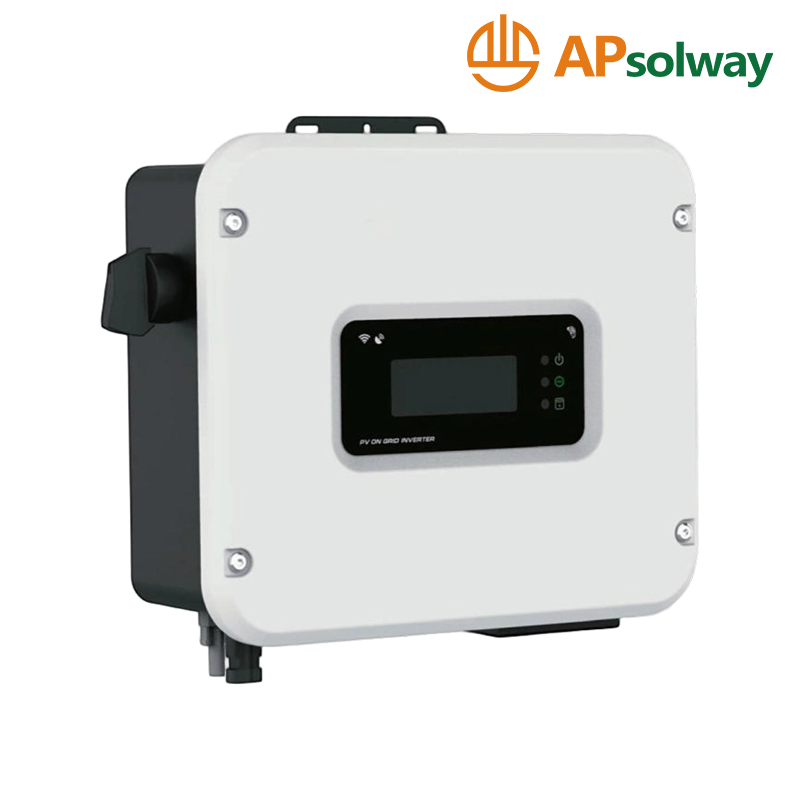
A string inverter connects to a series of solar panels wired together in a "string." All panels in the string feed into a single centralized inverter, which handles the DC-to-AC conversion for the entire array. String inverters are the most cost-effective option and have been the industry standard for decades. They are straightforward to install, easy to maintain, and have a long track record of reliability. Their main limitation is performance sensitivity to shading and panel mismatch: because the panels are wired in series, the output of the entire string is limited by the weakest-performing panel. A single shaded panel can reduce the output of every panel in the string. String inverters are best suited for rooftops with consistent, unobstructed sunlight and a single uniform orientation.
Microinverters
Microinverters are small units installed directly on the back of each individual solar panel. Each panel operates independently, converting its own DC output to AC at the panel level. This architecture eliminates the shading and mismatch problem entirely — a shaded or dirty panel has no effect on its neighbors. Microinverters also enable panel-level monitoring, so you can identify exactly which panel is underperforming at any time. The trade-offs are higher upfront cost (typically 20–30% more than a string inverter system of equivalent capacity) and more complex installation due to the larger number of units. However, microinverters carry long warranties — commonly 25 years — matching the lifespan of the panels themselves. They are the right choice for rooftops with partial shading, multiple roof planes, or mixed orientations.
Power Optimizers with a String Inverter
DC power optimizers represent a middle path. Like microinverters, they are installed at each panel and perform panel-level MPPT, conditioning the DC output before sending it to a central string inverter for conversion to AC. This architecture captures most of the shading and mismatch benefits of microinverters while keeping the main conversion hardware in a single, accessible, ground-level location. The system cost falls between string inverters and full microinverter installations. SolarEdge is the dominant manufacturer in this space, and their systems offer detailed panel-level monitoring through a cloud-based platform. Power optimizers are an excellent choice when some shading is unavoidable but you still want the serviceability and lower cost of a centralized inverter.
Hybrid Inverters: Adding Battery Storage to Your System
A hybrid inverter (also called a multi-mode inverter) combines the functions of a solar inverter and a battery inverter/charger in a single unit. It manages energy flow between the solar panels, battery bank, household loads, and the grid simultaneously. Hybrid inverters allow you to store excess solar generation in batteries for use at night or during grid outages, and they can be programmed to prioritize self-consumption, time-of-use rate optimization, or backup power depending on your utility tariff and priorities.
When specifying a hybrid inverter, two capacity figures matter: the continuous AC output power (how much power it can deliver to your home at any moment) and the battery charge/discharge rate (how quickly it can store or release energy). A 5 kW hybrid inverter with a 5 kWh battery, for example, can power up to 5 kW of loads simultaneously but can only do so for approximately one hour before the battery is depleted — assuming no solar input. Brands such as SolarEdge, Fronius, Growatt, Sungrow, and Huawei all offer hybrid models with varying levels of backup capability, battery compatibility, and monitoring sophistication.
Off-Grid Inverters for Stand-Alone Systems
Off-grid inverters are designed for systems that have no connection to the utility grid. They must manage the complete energy balance of an isolated system — regulating battery charging from solar and sometimes a backup generator, inverting stored DC power to AC for household use, and protecting against battery over-discharge. Off-grid inverters are commonly paired with a separate solar charge controller (MPPT controller), or the charge control function may be built in. They are sized not only for peak load but also for surge capacity, since motors (pumps, refrigerators, air conditioners) draw two to six times their rated current at startup. A refrigerator rated at 200W may require a 1,200W surge capacity from the inverter at startup. Off-grid systems require careful battery bank sizing and are most appropriate for remote properties, boats, and cabins where grid connection is impractical or prohibitively expensive.
Key Specifications to Compare When Choosing an Inverter
Once you have identified the inverter type that suits your installation, comparing specific technical specifications allows you to narrow down the shortlist. The following table summarizes the most important parameters:
| Specification | What It Means | What to Look For |
| CEC Efficiency | Weighted average efficiency across real-world operating conditions | 97% or higher for string inverters; 96%+ for microinverters |
| MPPT Range | DC voltage window within which the inverter actively tracks maximum power | Wide range (e.g., 200–800V) allows more panel configuration flexibility |
| Number of MPPT Inputs | How many independent strings the inverter can optimize separately | Two or more for rooftops with multiple orientations or shading zones |
| Warranty | Manufacturer's guarantee period covering defects and performance | 10 years minimum for string inverters; 25 years for microinverters |
| Ingress Protection (IP) Rating | Resistance to dust and water ingress | IP65 or higher for outdoor installation |
| Monitoring Platform | App or web portal for tracking generation, consumption, and faults | Real-time data, historical logging, alert notifications |
Sizing Your Inverter Correctly
Inverter sizing is one of the most consequential decisions in system design. The inverter's AC output capacity (measured in kilowatts, kW) does not need to equal the total DC capacity of the solar array (measured in kilowatt-peak, kWp). In fact, a common and cost-effective practice is to slightly oversize the array relative to the inverter — a technique called DC oversizing or inverter clipping. For example, pairing a 5 kW inverter with 6.5 kWp of panels allows the system to reach the inverter's maximum output for more hours per day (during morning and afternoon shoulder periods) without meaningfully sacrificing peak-hour production, since solar panels rarely reach their rated output in real-world conditions. Most grid-connected inverter manufacturers permit DC-to-AC ratios of up to 1.33:1, and many installers design to ratios of 1.2–1.25:1 as standard practice.
For hybrid and off-grid systems, the inverter must also be sized to handle the peak instantaneous load you expect to run simultaneously. Add up the wattage of every appliance you might use at the same time during a power outage or off-grid scenario, then add a 25% safety margin. If you plan to run a 3-ton central air conditioner (approximately 3,500W running, 10,000W+ startup surge), a refrigerator, lighting, and a television simultaneously, you need an inverter with both sufficient continuous capacity and adequate surge rating to handle motor startups without tripping.
Making the Final Decision: A Framework by Situation
No single inverter type is universally best. The right choice depends on your specific installation conditions, financial priorities, and long-term goals. Use the following criteria to guide your decision:
- Unshaded roof, single orientation, budget-conscious: A string inverter from a reputable brand (Fronius, SMA, Sungrow) offers the best value. Prioritize CEC efficiency above 97% and a warranty of at least 10 years with an extendable option.
- Partial shading or multiple roof planes: Microinverters (Enphase) or a power optimizer system (SolarEdge) will recoup their additional cost through higher energy yield. Microinverters are preferable if long-term serviceability and panel-level warranty alignment are priorities.
- Battery storage planned now or in the future: Choose a hybrid inverter with confirmed compatibility with your target battery chemistry (lithium iron phosphate is the current standard for residential use). Verify that the inverter supports the backup load panel configuration required by your local code.
- Remote property or no grid access: An off-grid inverter/charger (Victron Energy, Outback Power, Schneider Electric) combined with a properly sized battery bank and backup generator is the appropriate solution. Engage a qualified off-grid system designer to size the battery bank for your seasonal load profile.
- Commercial or large residential system above 15 kW: Three-phase string inverters reduce per-watt cost and balance grid loading. Confirm your utility's interconnection requirements and anti-islanding standards before finalizing the specification.
Whichever inverter you choose, verify that it carries the certifications required in your jurisdiction — UL 1741 and IEEE 1547 in the United States, VDE-AR-N 4105 in Germany, AS/NZS 4777 in Australia — and that your installer is authorized by the manufacturer to commission the unit. A correctly specified, properly installed inverter will reliably anchor your solar system for the next two to three decades.
- Mp: +86-13819379269 / 15726870289
- Tel: +86-573-83705988
- Fax: +86-573-83705966
- E-mail: [email protected]
- Add: 10th Floor, Haizhou Star, Xiuzhou District, Jiaxing City, Zhejiang, China 314000
 Privacy
Solar Inverters Manufacturers
Privacy
Solar Inverters Manufacturers