
 EN
EN English
 Español
 عربى
عربى


Which Solar Inverter Is Right for Your Home — and How Do You Choose?
Content
- 1 What Does a Solar Inverter Actually Do?
- 2 The Four Main Types of Solar Inverters
- 3 Comparing the Four Inverter Types Side by Side
- 4 Key Specifications to Evaluate When Choosing a Solar Inverter
- 5 Grid-Tied, Off-Grid, or Hybrid: Choosing the Right System Architecture
- 6 Practical Questions to Ask Before Finalising Your Inverter Choice
What Does a Solar Inverter Actually Do?
A solar inverter is the central processing unit of any photovoltaic (PV) system. Solar panels generate direct current (DC) electricity — a steady, unidirectional flow of electrons — but virtually every appliance in a home or business runs on alternating current (AC), where the direction of current reverses at a fixed frequency (50 Hz in Europe and Australia, 60 Hz in North America). The inverter's primary job is to convert DC from the panels into grid-compatible AC that your loads can use. Beyond that fundamental conversion, a modern solar inverter also performs maximum power point tracking (MPPT), which continuously adjusts the electrical operating point of the panels to extract the maximum available power as sunlight intensity and panel temperature change throughout the day.
Most grid-tied inverters also handle grid synchronization, safety disconnection (anti-islanding), and data monitoring. Higher-end models integrate battery charge management, export limiting, and demand response features. The inverter you choose defines not just how efficiently your system converts solar energy, but also how much visibility and control you have over the system's performance over its operational life — typically 10 to 15 years before an inverter requires replacement, compared to 25 to 30 years for quality solar panels.
The Four Main Types of Solar Inverters
The inverter market has diversified considerably over the past decade, and the choice between inverter types has become one of the most consequential decisions in system design. Each type suits a different combination of roof configuration, shading conditions, budget, and future expansion plans.
String Inverters
A string inverter connects a series string of solar panels — typically 8 to 15 panels wired in sequence — to a single centralized inverter unit, usually mounted on an exterior wall near the main switchboard. String inverters are the most established technology, the lowest cost per watt, and the simplest to install and maintain. Their main limitation is that the entire string performs only as well as its weakest panel. If one panel is shaded by a chimney, tree, or bird dropping, the output of every panel in that string is reduced proportionally. For roofs with no shading, a single unobstructed orientation, and modest system sizes below 10 kW, a string inverter remains an excellent value proposition.
Microinverters
Microinverters are small inverters mounted directly behind each individual solar panel, converting DC to AC at the panel level rather than centrally. Because each panel operates independently, partial shading, soiling, or a panel fault affects only that one panel rather than an entire string. Microinverters also allow panel-level monitoring, so you can see the output of every individual panel in real time. They carry a higher upfront cost — typically 20 to 30% more than a comparable string inverter system — but are well-suited to complex roofs with multiple orientations, roofs with unavoidable shading, or situations where the system will be expanded incrementally over several years since additional panels can be added one at a time without redesigning the string configuration.
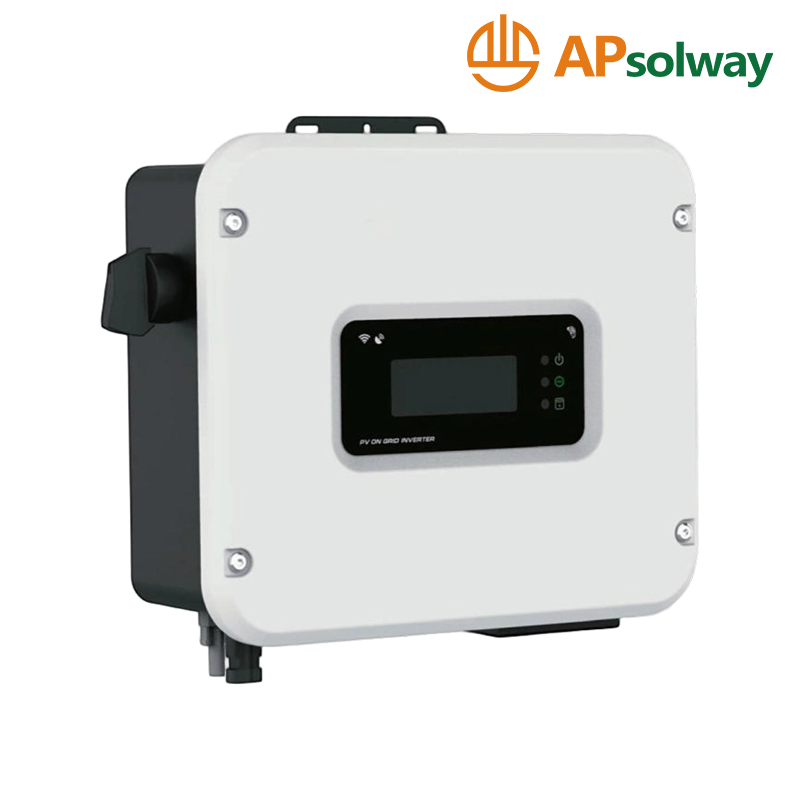
Power Optimizers with a String Inverter
Power optimizers are a hybrid approach. A DC optimizer is attached to each panel — similar to a microinverter — but instead of converting DC to AC at the panel, it performs MPPT at the panel level and then passes a conditioned DC signal to a centralized string inverter for final conversion. This approach eliminates the string-level shading penalty of a standard string inverter while retaining the cost advantage of a single centralized inverter for the AC conversion stage. SolarEdge is the dominant provider of this architecture. Power optimizers add cost and complexity compared to a plain string inverter, but less than microinverters, and they are a practical choice for moderately complex roofs where full microinverter deployment is not cost-justified.
Hybrid Inverters
A hybrid inverter — also called a battery-ready or multi-mode inverter — combines a solar inverter with a battery charge controller in a single unit. It manages power flows between the solar panels, a battery bank, the household loads, and the grid simultaneously. Hybrid inverters are the correct choice for any system being designed with battery storage from the outset, or for any system where battery retrofit is a realistic future plan. Installing a hybrid inverter upfront and adding a battery later is significantly cheaper than replacing a standard string inverter with a hybrid unit at the time of battery installation.
Comparing the Four Inverter Types Side by Side
| Inverter Type | Shading Tolerance | Relative Cost | Battery Ready | Best For |
| String Inverter | Low | Lowest | No (standard) | Unshaded, single-pitch roofs |
| Microinverter | High | Highest | Some models | Complex / shaded roofs, modular expansion |
| Power Optimizer + String | High | Medium-High | Some models | Moderate shading, panel-level monitoring |
| Hybrid Inverter | Medium | Medium-High | Yes | Battery storage now or planned |
Key Specifications to Evaluate When Choosing a Solar Inverter
Once you have identified the inverter type that suits your installation, comparing specific models requires evaluating a set of technical specifications that directly affect system performance and long-term reliability. The following parameters deserve careful attention rather than a quick scan of the marketing summary.
- Efficiency: The CEC (California Energy Commission) weighted efficiency or European efficiency rating reflects real-world performance more accurately than peak efficiency figures, which only apply at a single, rarely-achieved operating point. Look for CEC efficiency above 97% for string inverters and above 96% for hybrid units. Even a 1% difference in efficiency across a 6 kW system compounding over 10 years represents a measurable difference in total energy generated.
- MPPT inputs and voltage range: Multiple MPPT inputs allow panel strings on different roof orientations or with different shading profiles to be managed independently, preventing one string from pulling down another. Check that the inverter's MPPT voltage range encompasses the expected open-circuit voltage of your panel array across the full temperature range of your climate — panels generate higher voltages in cold weather, and an inverter with a narrow MPPT range may not capture that additional output.
- Continuous output power rating: The inverter's AC output rating in kilowatts should be matched to the total DC capacity of the panel array. Most grid-tied systems are designed with a DC-to-AC ratio (also called the inverter loading ratio) of 1.1 to 1.25 — meaning a 5 kW inverter might be paired with 5.5 to 6.25 kW of panel capacity. This is intentional: panels rarely produce their rated output, and a slightly undersized inverter allows you to install more panels and capture more energy at moderate irradiance levels without wasting money on inverter capacity that rarely gets used.
- Warranty duration: Standard string inverter warranties run 5 to 10 years, with extensions typically available for purchase. Given that an inverter replacement mid-system-life costs $1,000 to $2,500 including labor, a 10-year standard warranty or a 12-year extended warranty is worth paying a modest premium for. Microinverter manufacturers generally offer 25-year warranties aligned with panel warranties, reflecting the inherent redundancy of distributed architecture.
- Monitoring platform: A good monitoring platform shows you daily, monthly, and lifetime energy production; real-time power output; and fault alerts when a component underperforms or stops reporting. For string inverters this is system-level data. For microinverter and power optimizer systems it is panel-level data, which allows you to identify a faulty or soiled panel without a manual roof inspection. Confirm that the monitoring platform is included in the purchase price and does not require an ongoing subscription fee that could become a nuisance cost over the system's lifetime.
Grid-Tied, Off-Grid, or Hybrid: Choosing the Right System Architecture
The inverter type you need is partly determined by whether your system will remain connected to the utility grid, operate entirely independently, or combine both capabilities. Grid-tied systems — by far the most common residential configuration — use a standard or hybrid inverter connected to the grid. They benefit from net metering or feed-in tariff arrangements that allow excess solar energy to be exported for credit, and they draw grid power automatically when solar production is insufficient. Grid-tied inverters are legally required to shut down during a grid outage (anti-islanding protection) unless the inverter includes an emergency backup function.
Off-grid systems, used in remote properties without grid access, require a different class of inverter — typically a low-frequency inverter or a dedicated off-grid hybrid unit — combined with a battery bank sized to cover overnight demand and several days of poor weather. These systems are substantially more complex and expensive to design correctly, and they require load management discipline that grid-connected households rarely need. For properties that could be connected to the grid at reasonable cost, an off-grid system is rarely the most economical choice. For genuinely remote locations where grid connection would cost tens of thousands of dollars, a well-designed off-grid system with modern lithium battery storage and a quality inverter/charger provides reliable, independent power.
Practical Questions to Ask Before Finalising Your Inverter Choice
Narrowing down inverter options is easier when you work through a short set of practical questions that reflect your specific situation rather than applying a generic recommendation. The answers to these questions will point you toward the appropriate inverter type and help you filter the market to a manageable shortlist of models worth requesting quotes for.
- Does your roof have shading from trees, chimneys, neighboring buildings, or antenna masts during daylight hours? If yes, eliminate standard string inverters from consideration and evaluate microinverters or power optimizers instead.
- Do you plan to add battery storage within the next five years? If yes, specify a hybrid inverter now even if you are not purchasing a battery today. The incremental cost over a standard string inverter is typically $500 to $1,500 — far less than replacing the inverter later.
- Is your roof a single pitch facing the optimal direction for your latitude, or does it have multiple faces at different orientations? Multiple orientations require either microinverters, power optimizers, or a multi-MPPT string inverter with separate strings on each face.
- What is the local installer's experience and preferred brand? An installer who has serviced hundreds of units from a particular manufacturer can diagnose faults faster, has established relationships with the warranty support team, and is less likely to make wiring errors on a familiar platform. Brand preference backed by installation volume is a legitimate factor in a final decision between two otherwise comparable products.
- What are the local grid export rules? Some utilities cap the amount of power a residential system can export, which affects whether oversizing the inverter relative to your consumption makes economic sense. Confirm the applicable export limit with your network operator before finalizing system size and inverter capacity.
A solar inverter is a long-term investment in the performance of your entire PV system. Matching the inverter type and specifications to your actual roof conditions, consumption patterns, and future plans — rather than defaulting to the cheapest option or the most heavily marketed brand — is the single most effective step you can take to ensure the system delivers consistent value across its full operational life.
- Mp: +86-13819379269 / 15726870289
- Tel: +86-573-83705988
- Fax: +86-573-83705966
- E-mail: [email protected]
- Add: 10th Floor, Haizhou Star, Xiuzhou District, Jiaxing City, Zhejiang, China 314000
 Privacy
Solar Inverters Manufacturers
Privacy
Solar Inverters Manufacturers