

 EN
EN English
 Español
 عربى
عربى

Which Type of Solar Inverter Is the Right Choice for Your Photovoltaic System?
The solar inverter is the brain of any photovoltaic system. While solar panels generate direct current (DC) electricity from sunlight, virtually every appliance in a home or commercial building runs on alternating current (AC). The inverter performs this conversion, and its design has a profound effect on how efficiently the system operates, how well it handles shading or panel mismatch, how easy it is to monitor, and what happens when the grid goes down. Choosing the wrong inverter type for a given installation can reduce energy yield, complicate maintenance, and limit future expansion options. This guide breaks down each major inverter type, how it works, where it performs best, and what trade-offs it introduces.
String Inverters: The Established Standard for Uniform Arrays
String inverters connect a series of solar panels — called a string — into a single inverter unit that handles all the DC-to-AC conversion for that string. They are the oldest and most widely deployed inverter architecture, valued for their straightforward installation, proven reliability over decades of field use, and comparatively low cost per watt of capacity. A residential installation might use one or two string inverters; a large commercial roof might use a dozen or more, each serving a separate array section.
The defining characteristic of string inverter architecture is that the entire string operates at the performance level of its weakest panel. If one panel in a string is partially shaded, soiled, or degraded, its reduced output constrains the current flowing through every other panel in that string — a limitation known as the "Christmas light effect." This makes string inverters best suited to installations where all panels face the same direction, receive similar irradiance throughout the day, and are unlikely to experience differential shading. A south-facing unobstructed roof in a location with long sunny days is the ideal environment for string inverters to deliver their full efficiency potential, which typically reaches 97 to 98 percent under optimal conditions.
When String Inverters Are the Right Choice
String inverters remain the cost-effective default for residential and commercial installations with unshaded, single-orientation arrays. Their centralized design means fewer electronic components overall, making maintenance and fault diagnosis simpler than distributed architectures. When one unit fails, it is straightforward to identify and replace. For large ground-mounted solar farms where uniform conditions exist across the entire array, string inverters — often combined with DC optimizers on individual panels — deliver a compelling cost-per-kilowatt-hour outcome over the system's 25-year lifespan.
Microinverters: Panel-Level Independence for Complex Roofs
A microinverter is a small inverter unit mounted directly on the back of each individual solar panel, converting that panel's DC output to AC at the point of generation. Unlike string inverters, microinverters allow every panel to operate independently at its own maximum power point, meaning shading, soiling, or degradation on one panel has no effect on the performance of any other panel in the array. This panel-level independence makes microinverters the preferred choice for roofs with multiple orientations, complex geometry, or persistent partial shading from chimneys, dormers, or nearby trees.
Microinverters also simplify system expansion, since additional panels and their paired microinverters can be added without replacing or reconfiguring the existing inverter equipment. Each panel reports its own production data to a monitoring platform, giving installers and homeowners granular visibility into the performance of every individual module. The trade-off is cost: microinverters add roughly 15 to 25 percent to the inverter component cost compared to an equivalent string inverter installation, and having more electronic units means more potential points of failure over the system's lifetime — though individual microinverter failure affects only one panel's output rather than an entire string.
Power Optimizers: A Hybrid Approach Combining Both Architectures
DC power optimizers occupy a middle ground between string inverters and microinverters. Each panel is paired with an optimizer unit that performs maximum power point tracking (MPPT) at the panel level, conditioning the DC output before sending it to a central string inverter for the final DC-to-AC conversion. This means each panel operates at its own optimal voltage and current regardless of what neighboring panels are doing, eliminating the string-level performance bottleneck of a standard string inverter, while still using a single central inverter for the AC conversion step.
The result is a system that handles shading and mismatch nearly as well as a full microinverter installation, at a lower total component cost and with the maintenance simplicity of a centralized inverter. When the string inverter fails or requires service, the power optimizers on each panel continue to provide MPPT conditioning, and the system can be restored by replacing a single inverter unit rather than diagnosing multiple microinverter locations. Optimizer-plus-string-inverter systems are now among the most widely installed configurations in markets with complex residential rooflines, particularly where installer labor costs are high and minimizing site time is a priority.
Central Inverters: High-Capacity Solutions for Utility-Scale Projects
Central inverters are large, high-capacity units designed for utility-scale solar farms, industrial installations, and large commercial carports or ground-mounted arrays. A single central inverter can handle from 500 kilowatts to several megawatts of DC input, aggregated from many parallel strings feeding a combiner box before entering the inverter. This architecture maximizes energy density and minimizes the per-watt cost of the inverter hardware, but concentrates the risk: if the central inverter fails, a large proportion of the array is offline until the unit is repaired or replaced.
Central inverters are installed in dedicated inverter rooms or containerized enclosures rather than being mounted on the array structure itself. Their sheer size and weight require concrete foundations and dedicated access for maintenance personnel and lifting equipment. For utility developers building solar farms of 10 megawatts and above, the economics of central inverters remain compelling — the lower capital cost per megawatt, combined with simplified electrical infrastructure compared to a field of string inverters, produces a lower levelized cost of energy over the project's 20 to 30 year operating life.
Hybrid Inverters: Integrating Solar, Storage, and the Grid
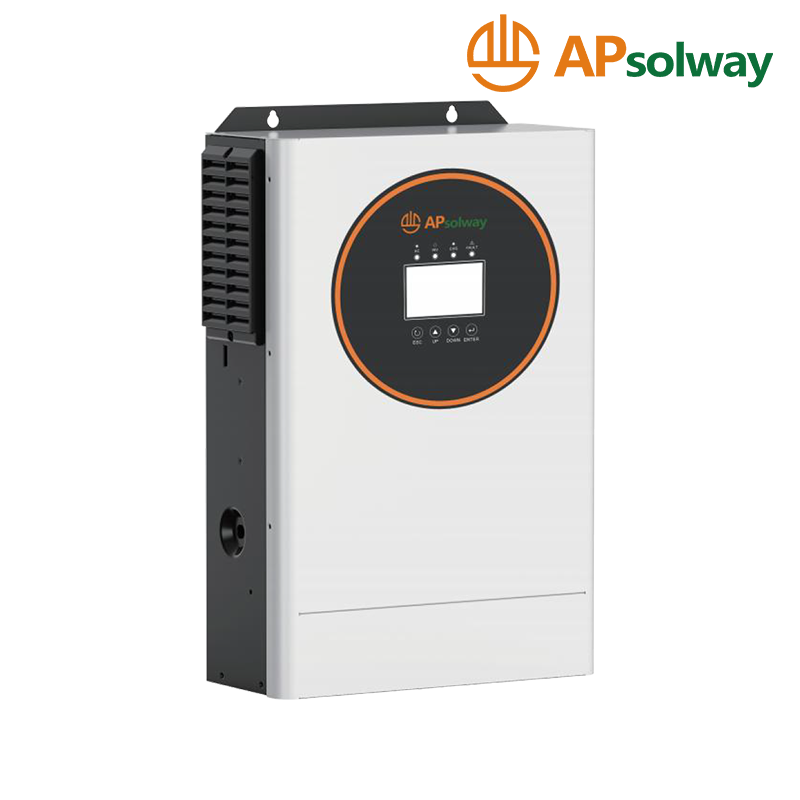
Hybrid inverters — also called multi-mode or storage-ready inverters — manage solar generation, battery storage, grid import and export, and backup power loads within a single integrated unit. They are the core technology in solar-plus-storage residential and commercial systems, enabling households and businesses to self-consume their solar generation, store surplus energy for evening use, and maintain power supply during grid outages through their built-in transfer switch functionality.
A hybrid inverter continuously monitors the solar generation, battery state of charge, grid conditions, and load demand, making real-time decisions about energy flow direction. During the day, excess solar beyond immediate consumption charges the battery. In the evening, the battery discharges to offset grid import. During a grid outage, the inverter disconnects from the grid, forms a local AC microgrid, and manages the solar and battery resources to supply critical loads. The sophistication of this energy management logic varies significantly between products — entry-level hybrid inverters offer basic self-consumption optimization, while advanced units incorporate time-of-use tariff optimization, demand response participation, and vehicle-to-home (V2H) charging integration.
Side-by-Side Comparison of Solar Inverter Types
Selecting an inverter type involves balancing installation cost, energy yield, system complexity, monitoring capability, and future flexibility. The table below summarizes how each type performs across the key decision criteria:
| Inverter Type | Best Application | Shading Tolerance | Relative Cost | Monitoring |
| String Inverter | Uniform, unshaded arrays | Low | Low | String level |
| Microinverter | Complex roofs, shading | Very High | High | Panel level |
| Power Optimizer + String | Mixed orientation, partial shade | High | Medium | Panel level |
| Central Inverter | Utility-scale solar farms | Low | Lowest per watt | Array level |
| Hybrid Inverter | Solar + battery storage | Medium | High | System level |
Key Factors to Consider Before Choosing an Inverter Type
No single inverter type is optimal for every installation. The right choice depends on a combination of site-specific, financial, and future-planning factors that should be evaluated together rather than in isolation. Before specifying an inverter, the following questions help narrow the selection:
- Is the roof or ground area subject to shading? Even brief shading from a chimney, vent stack, or tree branch for a few hours per day can reduce annual output by 10 to 20 percent on a string inverter system. If shading is present, microinverters or optimizers recover a substantial portion of that lost energy.
- Does the array face multiple orientations? East-west split arrays, L-shaped roofs, and installations that combine roof sections at different tilts require either multiple string inverters per orientation, or a distributed architecture that manages each panel independently.
- Is battery storage planned now or in the future? Installing a hybrid inverter from the outset avoids the cost and complexity of retrofitting storage capability later. Some string inverters can be paired with AC-coupled battery systems, but native hybrid inverters provide more seamless integration and broader feature sets.
- Is backup power during grid outages a requirement? Standard string and microinverters shut down automatically when the grid fails, a safety requirement that prevents reverse feeding into de-energized lines. Only hybrid inverters with a certified islanding capability can maintain supply to designated circuits during an outage.
- What is the project scale and budget? For systems above 100 kilowatts, the economics typically favor string or central inverters with optimizers on shaded panels, rather than full microinverter coverage, which becomes cost-prohibitive at scale.
Understanding these distinctions before signing a solar installation contract ensures the inverter technology chosen matches the specific conditions of the site, the operational priorities of the owner, and the long-term direction of the energy system. Inverters represent 10 to 15 percent of a typical system's installed cost but have an outsized effect on lifetime energy production, making the selection decision well worth the time invested in getting it right.
