
 EN
EN English
 Español
 عربى
عربى


What Do You Need to Know Before Choosing an Off-Grid Solar Inverter?
Content
- 1 What Does an Off-Grid Solar Inverter Actually Do?
- 2 The Three Main Types of Off-Grid Solar Inverters
- 3 How to Size an Off-Grid Solar Inverter Correctly
- 4 Battery Voltage Compatibility and Bank Sizing
- 5 Key Features to Evaluate When Comparing Off-Grid Inverters
- 6 Common Off-Grid Inverter Installation Mistakes to Avoid
- 7 Evaluating Total Cost of Ownership, Not Just Purchase Price
What Does an Off-Grid Solar Inverter Actually Do?
An off-grid solar inverter is the central power conversion component in any standalone solar energy system that operates entirely independently of the utility grid. Its primary function is to convert the direct current (DC) electricity stored in a battery bank into alternating current (AC) electricity that can power standard household appliances, tools, and equipment. Unlike grid-tied inverters, which synchronize with and feed power back into the utility network, off-grid inverters must generate their own stable AC voltage and frequency reference entirely from the battery supply — typically producing a pure sine wave output at 120V/60Hz in North America or 230V/50Hz in Europe and most of the rest of the world.
In most practical off-grid systems, the inverter does considerably more than simple DC-to-AC conversion. Modern off-grid inverters integrate battery charging from both solar panels (via a built-in MPPT or PWM charge controller) and from a backup generator or shore power source, manage load prioritization, provide system monitoring via LCD displays or Bluetooth and Wi-Fi connectivity, and protect both the battery bank and connected loads from conditions such as overload, over-temperature, low battery voltage, and short circuits. Understanding this broader functional scope is essential for selecting an inverter that can reliably serve as the operational heart of a complete off-grid power system.
The Three Main Types of Off-Grid Solar Inverters
Off-grid solar inverters are not a single product category — they span several distinct types, each suited to different system architectures, budgets, and performance requirements. Choosing the wrong type for a given application is one of the most common and costly mistakes in off-grid system design.
Pure Sine Wave Inverters
Pure sine wave inverters produce an AC output waveform that is virtually identical to the smooth, sinusoidal power delivered by the utility grid. This makes them compatible with all categories of electrical loads, including sensitive electronics such as variable frequency drives, medical equipment, audio systems, laser printers, and any appliance with a microprocessor-based control board. The higher manufacturing complexity of pure sine wave technology makes these units more expensive than modified sine wave alternatives, but for most off-grid residential and commercial installations, pure sine wave output is the only acceptable specification. Attempting to run sensitive equipment on a lower-quality waveform risks equipment damage, reduced efficiency, and audible interference in audio and video devices.
Modified Sine Wave Inverters
Modified sine wave inverters produce a stepped approximation of a sine wave — essentially a square wave with an intermediate zero-voltage step inserted to reduce harmonic distortion compared to a pure square wave. They are significantly less expensive than pure sine wave units and are adequate for powering resistive loads such as incandescent lighting, simple heating elements, and basic power tools. However, they are incompatible with many modern appliances and can cause motors to run hotter and less efficiently, reduce battery charger performance in devices with internal transformer-based chargers, and introduce audible hum into audio equipment. Modified sine wave inverters are generally appropriate only for very basic, low-budget, or temporary off-grid setups where load compatibility has been carefully verified in advance.
Inverter-Chargers (Hybrid Off-Grid Inverters)
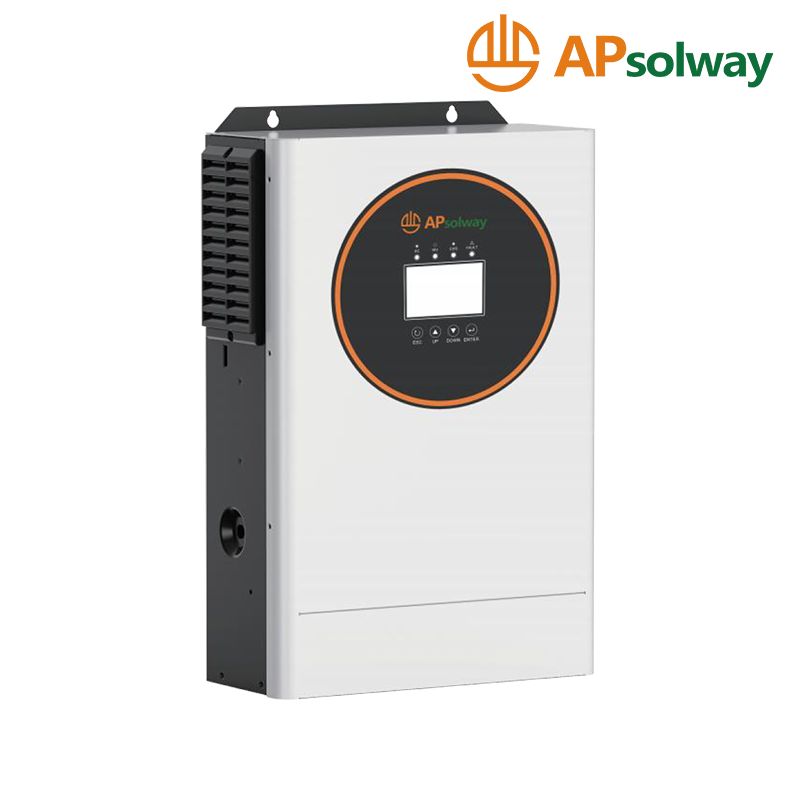
Inverter-chargers combine a pure sine wave inverter with a multi-stage battery charger and, in many cases, an MPPT solar charge controller into a single integrated unit. This is the most practical and commonly specified configuration for serious off-grid installations because it eliminates the need for separate charge controller and inverter components, reduces wiring complexity, and enables intelligent power management — automatically switching between solar charging, generator charging, and battery discharge based on programmed priorities and thresholds. Leading inverter-charger platforms from manufacturers such as Victron Energy, Schneider Electric, SMA, Outback Power, and Growatt offer advanced features including generator auto-start control, programmable charge profiles for lithium and lead-acid batteries, remote monitoring, and scalable parallel operation for larger power demands.
How to Size an Off-Grid Solar Inverter Correctly
Inverter sizing is the most technically critical step in off-grid system design and one where both undersizing and oversizing carry significant consequences. An undersized inverter will shut down or be damaged when peak loads exceed its rating, while a dramatically oversized inverter operates at low efficiency during typical light loads and draws unnecessary standby power that depletes the battery bank during low-generation periods. Accurate sizing requires calculating both continuous load and surge (peak) load requirements.
Calculating Continuous Load
Begin by listing every electrical load that may operate simultaneously and summing their rated wattages. This total represents the minimum continuous power output the inverter must sustain indefinitely without thermal throttling or shutdown. Include a safety margin of 20–25% above the calculated total to account for load variations, power factor effects on inductive loads, and future system expansion. For example, a system with a calculated simultaneous load of 2,400W should be specified with an inverter rated for at least 3,000W continuous output.
Accounting for Surge Power
Electric motors — found in refrigerator compressors, water pumps, air conditioners, power tools, and washing machines — draw two to seven times their rated running wattage for a fraction of a second during startup. This surge demand must be within the inverter's specified surge or peak power rating, which is the maximum output the unit can deliver for a short defined period (typically 5 to 30 seconds). An inverter with a 3,000W continuous rating might carry a 6,000W surge rating, which would comfortably handle a 1.5 HP well pump starting at approximately 4,500W surge while other loads are running. Always check the manufacturer's surge specification against the highest-surge load in the system before finalizing the inverter selection.
Battery Voltage Compatibility and Bank Sizing
Off-grid inverters are designed to operate from a specific DC input voltage that must match the battery bank configuration. Common system voltages are 12V, 24V, and 48V, with larger systems almost universally specified at 48V to minimize conductor sizing and reduce current-related resistive losses. The relationship between inverter power rating and recommended system voltage is straightforward: higher power systems require higher voltage to keep DC current at manageable levels.
| System Voltage | Typical Inverter Size Range | Best Suited For |
| 12V | Up to 2,000W | Vans, small cabins, basic lighting and device charging |
| 24V | 1,000W – 5,000W | Small homes, weekend cabins, moderate appliance loads |
| 48V | 3,000W – 15,000W+ | Full residential, farms, commercial off-grid facilities |
Battery chemistry is equally important for inverter compatibility. Most modern inverter-chargers support both traditional flooded lead-acid and sealed AGM/gel batteries, as well as lithium iron phosphate (LiFePO4) batteries, which have become the dominant choice in new off-grid installations due to their superior cycle life (2,000–6,000 cycles vs. 300–500 for lead-acid), higher usable depth of discharge (80–95% vs. 50% for lead-acid), and stable voltage profile throughout the discharge curve. When specifying a lithium battery bank, verify that the inverter's charge algorithm and BMS communication protocol are explicitly compatible with the chosen lithium battery brand to enable safe, optimized charging and proper low-voltage disconnect coordination.
Key Features to Evaluate When Comparing Off-Grid Inverters
Beyond power rating and battery compatibility, a range of functional features significantly differentiates off-grid inverter models and should be carefully evaluated against the specific requirements of each installation:
- Built-in MPPT Solar Charge Controller: Inverter-chargers with an integrated Maximum Power Point Tracking charge controller eliminate a separate component, reduce wiring, and enable tighter system integration. Verify the MPPT input voltage range and maximum solar input wattage against your planned solar array specifications — mismatches here are a common installation error.
- Transfer Switch and Generator Input: A fast automatic transfer switch (typically under 20 milliseconds) allows the inverter to seamlessly shift between battery-sourced power and generator or shore power input without interrupting sensitive loads. Auto-start generator control outputs are a valuable feature for unattended installations where the generator must activate automatically when battery state of charge drops below a set threshold.
- Programmable Charge Profiles: Multi-stage charging (bulk, absorption, float, and equalization for lead-acid) with fully adjustable voltage setpoints allows the charge algorithm to be precisely matched to the battery chemistry and manufacturer's specifications, maximizing battery life and preventing damage from incorrect charging.
- Remote Monitoring and Control: Wi-Fi or Ethernet connectivity enabling cloud-based monitoring through a manufacturer's app or platform (such as Victron's VRM portal or SMA's Sunny Portal) allows system performance to be tracked and faults to be diagnosed remotely — an essential capability for off-grid properties that are unoccupied for extended periods.
- Parallel and Three-Phase Stacking: For larger power requirements, some inverter platforms support connecting multiple identical units in parallel to multiply continuous output power, or in three-phase configuration to power three-phase industrial loads. This scalability allows a system to be expanded incrementally as power demands grow without replacing the entire inverter.
- Operating Temperature Range: Off-grid installations in extreme climates — both hot desert environments and cold mountain or arctic locations — require inverters rated for the expected ambient temperature extremes. Most standard inverters are rated for 0°C to 40°C operation with power derating above 25°C, but specialized models extend this range significantly in both directions.
Common Off-Grid Inverter Installation Mistakes to Avoid
Even a correctly specified inverter will underperform or fail prematurely if it is improperly installed. The following are the most frequently encountered installation errors in off-grid solar systems and the practical steps to avoid them:
- Undersized DC Cables: The DC cables between the battery bank and the inverter carry the highest currents in the entire system — often several hundred amperes at full load on a 48V system. Undersized cables introduce resistance that causes voltage drop, power loss as heat, and potential fire risk. Always size DC cables according to the inverter manufacturer's minimum cable specification and keep cable runs as short as physically possible, ideally under 1.5 meters.
- Poor Ventilation: Off-grid inverters generate significant heat under load and require adequate airflow around their heat sinks. Mounting an inverter in a sealed enclosure, a hot equipment room, or against an unventilated wall is a primary cause of thermal shutdowns and accelerated component aging. Follow the manufacturer's minimum clearance specifications and consider forced ventilation in warm climates.
- Incorrect Battery Charge Settings: Programming incorrect charge voltage setpoints — particularly the absorption and float voltages — is one of the most damaging mistakes in off-grid system commissioning. Overcharging lead-acid batteries causes electrolyte loss and plate damage; undercharging causes sulfation and premature capacity loss. Always enter the exact voltage parameters specified by the battery manufacturer for the chosen chemistry and temperature range.
- Missing Overcurrent Protection: A properly rated fuse or circuit breaker must be installed as close as physically possible to the positive battery terminal on the DC supply cable to the inverter. This protects against catastrophic short circuit current in the event of cable insulation failure. Many inverter failures and electrical fires in off-grid systems are directly attributable to the omission or incorrect sizing of this critical protection device.
Evaluating Total Cost of Ownership, Not Just Purchase Price
The purchase price of an off-grid solar inverter represents only a fraction of its total cost of ownership over a typical 10- to 15-year service life. Efficiency, reliability, warranty terms, and the availability of technical support and spare parts are all factors that significantly affect long-term operating costs and system uptime. A premium inverter-charger with a 97% conversion efficiency loses less than half the energy to heat compared to a 94% efficient budget unit — a difference that compounds daily over years of operation and reduces the required solar array and battery bank size, generating savings that often exceed the price premium within the first two to three years of operation.
Manufacturer warranty terms for off-grid inverters typically range from two to five years, with extended warranty options available from leading brands. Before purchasing, verify that the manufacturer maintains local technical support, provides firmware updates for the inverter's management software, and stocks replacement parts in the region where the system is installed. For remote off-grid locations where a system failure has serious consequences — a homestead without power, a remote medical clinic, or an agricultural operation dependent on pumped water — the quality and accessibility of post-sale support is as important a selection criterion as any technical specification on the product datasheet.
- Mp: +86-13819379269 / 15726870289
- Tel: +86-573-83705988
- Fax: +86-573-83705966
- E-mail: [email protected]
- Add: 10th Floor, Haizhou Star, Xiuzhou District, Jiaxing City, Zhejiang, China 314000
 Privacy
Solar Inverters Manufacturers
Privacy
Solar Inverters Manufacturers